Page loading


L’homme au coin

10 pages,
format 8,5 x 8,5 cm.
tirage à environ 30 exemplaires en typographie au plomb.
Thomas Braun
des fromages

8 pages,
format 11,2 x 9 cm.
tirage à 131 exemplaires en typographie.
CLS

Un volumen,
79 cm de long, 17,5 cm de haut.
tirage à 10 exemplaires en linogravure.
Marie-Rose de France

26 petits textes en proses poétique. Vignettes de CLS.
tirage à 120 exemplaires en typographie au plomb.

Flyer
Marie-Rose de France
|
|
36 p., format 10 x 14 cm. composé et imprimé en typographie au plomb Tirage à 120 exemplaires. (cliquer sur l'image pour en savoir plus) |

-

 Authors
-
Chronological
- • 1977 (1-12)
- • 1978 (13-23)
- • 1979 (24-27)
- • 1980 (28-39)
- • 1981 (40-52)
- • 1982 (53-64)
- • 1983 (65-74)
- • 1984 (75-97)
- • 1985 (98-114)
- • 1986 (115-120)
- • 1987 (121-127)
- • 1988 (128-134)
- • 1989 (-)
- • 1990 (135)
- • 1991 (136-138)
- • 1992 (139-144)
- • 1993 (145-153)
- • 1994 (154-163)
- • 1995 (164-172)
- • 1996 (173-188)
- • 1997 (189-194)
- • 1998 (195-196)
- • 1999 (197-201)
- • 2000 (202-206)
- • 2001 (207-213)
- • 2002 (214-220)
- • 2003 (221-224)
- • 2004 (225-226)
- • 2005 (227-229)
- • 2006 (230-231)
- • 2007 (232-237)
- • 2008 (238)
- • 2009 (239-247)
- • 2010 (248)
- • 2011 (249-251)
- • 2012 (252-255)
- • 2013 (256)
- • 2014 (257)
- • 2015 (-)
- • 2016 (258-260)
- • 2017 (261-263)
- • 2018 (264-269)
- • 2019 (270-273)
- • 2019 (274-276)
- • 2021 (277)
- • 2022 (278-281)
- • 2023 (282-284)
- • 2024 (285-285b)
- • 2025 (286-288)
- • 2026 (289)
-
Des barbares...
... for those who are too lazy to seek.
-
Biblioteratology
- • 01. Chez les brocheurs [1]
- • 02. Chez les éditeurs[1]
- • 03. Chez les relieurs [1]
- • 04. Chez les relieurs [2]
- • 05. Chez les éditeurs [2]
- • 06. At the readers [1]
- • 07. Chez les éditeurs [3]
- • 08. Chez les éditeurs [4]
- • 09. Chez les éditeurs [5]
- • 10. Chez les relieurs [3]
- • 11. At the bookstores [1]
- • 12. Among layout designers [1]
-
Entertainments
-
Fin-de-Siècle
-
Fourneau and Fornax
-
Printings
-
Typography
14903171 visitors
94 visitors online


Pink Hair
At the moment, I am sorting through my archives, trying to reorganise the stock of books from Le Fourneau (yes, I still have some!) and Fornax, and opening boxes that have not seen the light of day for donkey's years — perhaps even for several millennia. At the bottom of one such box, whose contents I had quite forgotten, I came across a printed sheet that brought back a few memories… memories dating from precisely the same period as the one that was the subject of my second remembrance (see →here).
It is 1973. I am a student at the école Estienne and, like all the other Estienne students at this distinguished school, which in those days still taught every trade associated with the art of the book, I am required to undertake a work placement. Naturally, it has to be with a company connected with the subjects I am studying. An education, I should add in passing, that I am absorbing with all the relish of an inveterate gourmand tucking into a rum baba (his favourite cake), the syrup running from the corners of his mouth.
However, true to the spirit of contradiction that has been developing in me since earliest childhood, I decide to choose a company that does not exactly conform to the school's orthodoxies: a screen-printing business, employing a technique that was not particularly held in high regard at the school at the time (see, once again, my second remembrance). And so off I go to do my placement at Trapinex, in Saulx-les-Chartreux, despite the disapproving pursing of lips at my revered school.
At Trapinex, I am welcomed with enthusiasm and respect. Just imagine! An Estienne student! One of those trained at the school that produces the cream of the profession (that, at any rate, was how the school presented itself to us, and presented us to the profession). The manager gives me permission to visit the various departments and make use of their facilities to produce a small document to accompany my work-placement report. I have an idea for this little document: a miniature book. The Trophée corrosif (second remembrance) has only recently been completed, and I conceive this little book along much the same lines, at least as far as the setting of the text is concerned: brush calligraphy. The writing, design and calligraphic execution of the layout are all done at home, away from Trapinex. I show the manager what I have in mind, he gives me the go-ahead, and I head for the photographic department to make the litho films that will be used to expose the screens. I am not one to cut corners: for my little 1/16th-format book, eight-up on each printing sheet, with a work-and-turn imposition (the same image being printed on both the front and back), which means that only one screen is needed for each colour. The miniature book is in two colours, so two screens in all.
Once I have imposed my two films, I make my way to the screen-making department. The exposure station is manned by a delightful lady of Portuguese origin, with an accent every bit as delightful, who explains how to prepare the light-sensitive coating by mixing the colloid with its sensitiser, potassium bichromate. I already know all this, of course, but I let her carry on, because she takes such pleasure in explaining her work. One should never deprive anyone of the pleasure of doing something they enjoy, or of taking pride in their work. She does not pronounce bichromate but micromate, which makes me smile inwardly. But never, absolutely never, does that smile make its way to my lips. I remain perfectly serious as I listen. My inward smile is one of affection, not amusement at her expense. We make the two screens. Or rather, she exposes and washes them out, while I watch.
Once the screens are dry, it is time to print. I have been granted permission to run the job on a small semi-automatic press. With this type of machine, while it is running, you have to keep your foot on a pedal to hold the screen in its raised position, allowing you to make the initial adjustments and then position the sheets to be printed. The moment you take your foot off the pedal, the screen comes down automatically, and the operator can print the sheet. I make my adjustments. Once everything is set, I spread the ink across the screen. It is a delicate orangey pink, specially mixed for me by one of the printers at Trapinex, to match the gouache colour sample I had given him. One sheet, two sheets, three sheets… everything is going swimmingly. I am getting the hang of the machine. Until the moment when I think I detect a faulty impression… some areas missing… probably because I have not applied enough pressure with the squeegee… I put my head underneath the screen to inspect the sheet… my foot slips off the pedal… the screen comes down, bursts over my head… and I find myself with pink hair!
At this point, I shall pause the story to show what I generally looked like in those days, which was rather different from my present appearance.
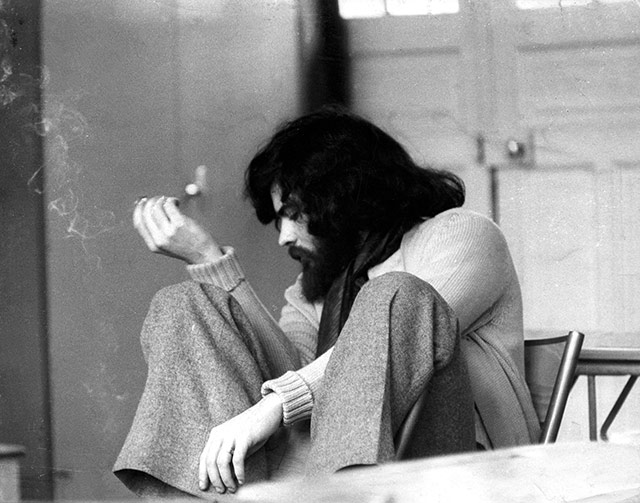
Photo of cls at Estienne, 1973.
The photograph was taken by a classmate in one of the classrooms at Estienne, during a break between lessons. I had a beard and long hair, flared trousers, and wore jumpers all year round (lighter ones in summer, thicker ones in winter). Yes, I was smoking. Yes, in those days you were allowed to smoke at school, even in the classroom (though not during lessons). The original silver-gelatin print, measuring 30 × 40 cm, is the only photograph I have from my Estienne days. It is, unfortunately, in a rather sorry state. Slightly blurred, with a dirty negative and negative carrier during enlargement, and a print with rather too much contrast. I had to do quite a bit of work on the scan to make the photograph presentable. End of interlude.
With my foot back on the pedal, I manage to raise the damaged screen. I switch off the machine and find myself standing there like a complete idiot, thoroughly ashamed and confused, like the raven in the fable, head thrust forward and bowed down to avoid getting ink on my clothes, while drops of ink fall from my hair. Hilarity throughout the workshop, naturally.
— Well, aren't those Estienne students a clever lot!
— Is that how they teach you to print at Estienne? With your head‽…
The kind lady from the screen-making department comes to my rescue, armed with a can of solvent and some white rags, to de-pink my head, while the others carry on laughing as much as they possibly can. The workshop manager arrives, drawn by the commotion, surveys the damage with an amused smile and lets me know that he would like to see me as soon as I have finished cleaning myself up. In private, he tells me that the accident does not mean the end of my miniature book project, but that he thinks it would be preferable for one of his own printers to finish the print run. I am welcome to stay and watch him at work for as long as I like.
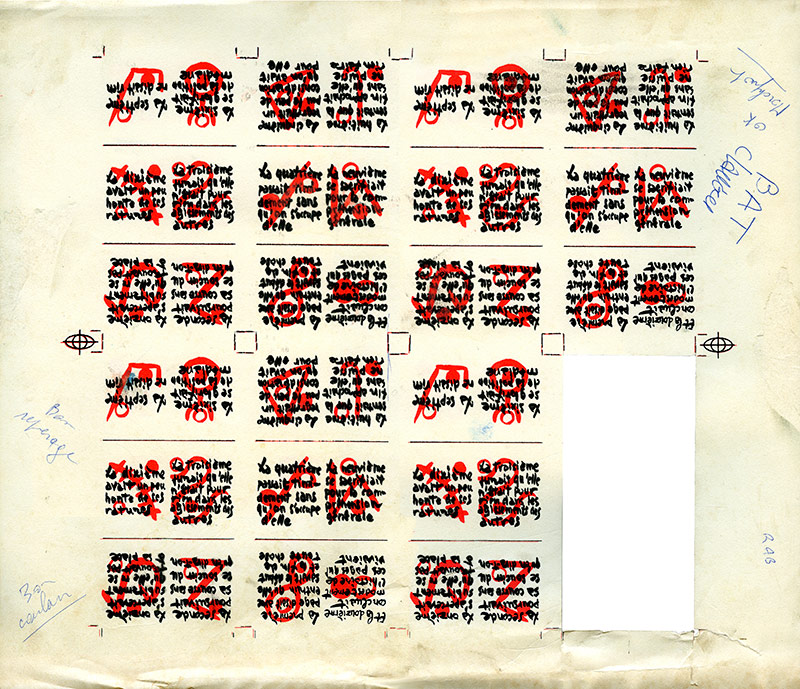
The miniature book's printer's proof (BAT)
Now that the laughter has subsided, the Trapinex staff begin to play along with me. I am no longer quite so much the hopeless Estienne trainee. Since I am no longer doing the printing myself, I am treated more or less like a customer. The printer checks that the pink ink matches my gouache sample. He checks the alignment of the two colours, as well as the register. And then he asks me to sign a printer's proof — a bon à tirer, or BAT, as we call it in French. It is this very sheet that I have just rediscovered at the bottom of a box of forgotten things. To make sure I had not made a mistake in imposing the miniature book, I had cut out one of the eight-up copies and folded it into a little book.
The rest of the placement passes without further incident, and I diligently record all my observations for my work-placement report. A report that I was supposed to defend orally at my final examination. In the end, I was spared that ordeal, having passed the written examination, which exempted me from all the oral exams. As I was the only person in my year not to have to sit this oral examination, I was obliged to convince myself that I must therefore have been top of the class. This did nothing for my vanity, but it did relieve me of a certain burden. I had not exactly prepared all the subjects for the oral examination thoroughly…
I was, however, left with the hundred sheets of two-colour printing from Trapinex that I had taken away with me at the end of my placement, together with a film for exposing the screen for the book's cover. And also the remainder of the pot of pink ink specially mixed for me. I printed the cover in my own screen-printing workshop, without putting my head through the screen this time.
The sheets from Trapinex would have allowed me to make 800 miniature books. I made quite a number of them. Fifty-three years later, I still have some left to produce. I make them to order only.
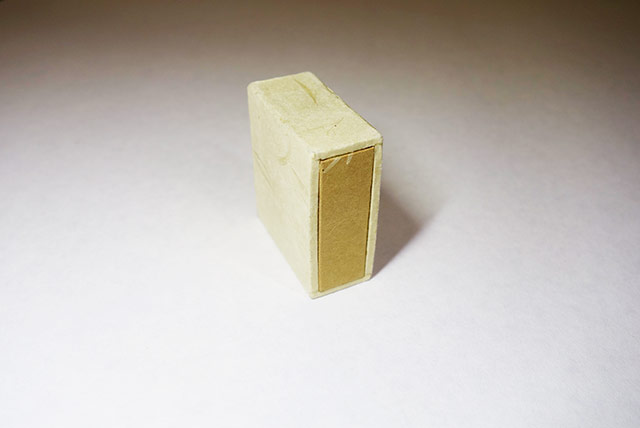
The box, wrapper and slipcase that I made at the time to hold four copies (the four different cover colours) of the Douze pages miniature book.
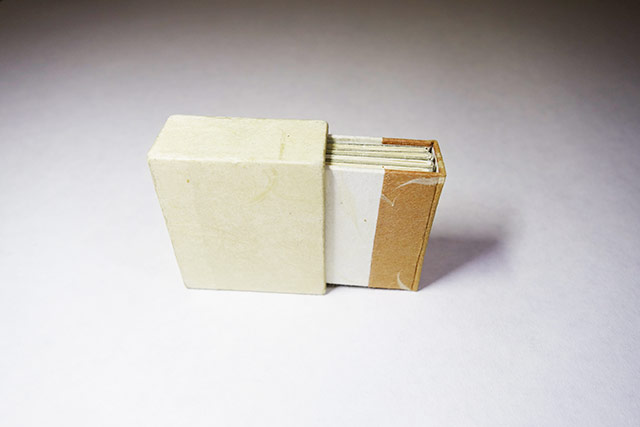
The box, slightly open.
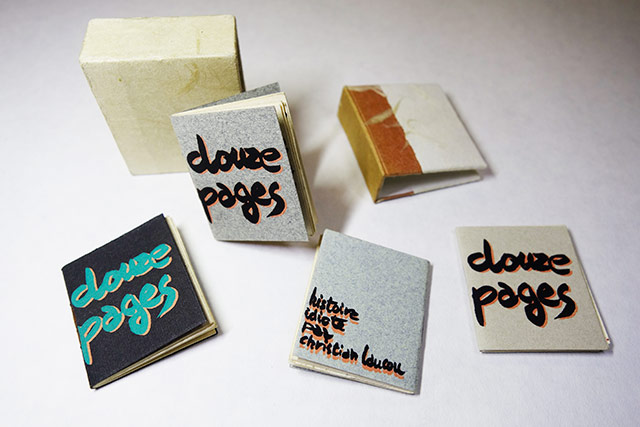
The four cover versions. The Douze pages (stupid story by Christian Laucou) miniature book measures 3.5 cm high by 3 cm wide.
Undergrowth typography
- • Attentiveness
- • Questioning
- • Begining
Typographical practice
- • Typography manual
- • Mould
- • Letterpress for beginners
- • Blains printing museum
- • A post card
- • A post card
- • Marabouts from A to D
- • Treading
- • Visit to Bannes
- • Homework
- • Curving machine
- • Haas and Frutiger
- • K crossed out
- • Word stamp
- • Hatching
- • Gutenberg in comics [2]
- • Champagne Printing Museum
- • Stamp
- • Gutenberg in comics [1]
- • Subscribed signs
- • Typofeminism
- • Rebais house of Printing
- • Cedilla
- • Versatur
- • Ben-day
- • Letters
- • wood types
- • Tours typography museum
- • Old book
- • Types...
- • Abbreviation
- • Height to paper
- • Mystery font
- • Typographic old times
- • Cleaning up a Della Robbia case
- • Type case [2]
- • Type case [1]
- • Bijou typographique n° 2 Émile Teillac
- • Restoration of an typo case
- • To murder the typo?
- • Little brother
- • Wishes 2014
- • Mould & library
- • Wishes 2013
- • Chromotypography
- • Wishes 2012
- • Decoration
- • The tools of the workshop [9]
- • The tools of the workshop [8]
- • The tools of the workshop [7]
- • The tools of the workshop [6]
- • The tools of the workshop [5]
- • The tools of the workshop [4]
- • The tools of the workshop [3]
- • The tools of the workshop [2]
- • The tools of the workshop [1]
- • Attrape-science
- • Drawing of the letter
- • Handbook
- • Atelier de Saint-Maur
- • Au courant
- • Gutenberg
- • Format typographique
- • Summer journey
- • Apostrophe
- • Baguette
- • Saint-Jean
- • Childishnesses
- • Logo
- • New typography at Estienne school
Typo des rues
Tools
- • Table
- • Specimen
- • Roller
- • Bellows
- • Invention patent
- • Magnifying Glass
- • Autograph presses -2
- • Autograph presses -1
- • Copy press
- • cardboard shears
- • Shear
The picture of the day...
- • Fresco
- • Treasure
- • Black and white
- • Papaver
- • Little prince...
- • Vegetable garden
- • Gâteaux
- • Macrosillon
- • Mills
- • Ring
- • Noise
- • Hedgehog
- • Hell
- • Sheep
- • Writing
- • Procrastination
- • Buffalo
- • Free
- • Enameled sheet metal
- • Emergency
- • VGT
- • Advice
- • Crucifixion
- • Plane tree (bis)
- • Garbage can
- • Pencil
- • Berries
- • Foresightedness
- • Heritage (continued)
- • Heritage
- • Mona
- • Craftsmen
- • Carrot
- • Ladybug
- • Punning signs
- • Weather report
- • Velocipede
- • Mysterious shop
- • Plane tree
- • Cathedral
- • Dissent
- • Heart
- • No entry
- • A-Z
- • Glass harmonica
- • Silence
- • Decentralization
- • Things
- • Julie
- • Socks
- • Cats (continued)
- • Rebus
- • Tit
- • Cats
- • Linen
- • Love story
- • Bowltree
- • Man
- • Athée (atheist)
- • Supposition
- • Cocktail
- • Arago
- • Hopscotch
- • Watchdog
- • Road safety
- • Queue
- • Tradition
- • Freedom
- • Curl up into a ball
- • Revelation
- • Chocolate
- • Easter Bunnies
- • Exhortation
- • An attempt...
- • Duplicity
- • Ores
- • Models
- • Estienne school
- • Anonymous letters
- • Heads
- • Game
- • Box
- • Consultant
- • Reflexions
- • Rain
- • Stencil and graffiti
- • Green
- • Nocturnal
- • Silence
- • Bliss
- • Volumen
- • Lack
- • Ant
- • Tube
- • Torn paper
- • On the ground
- • On the country lane
- • Music
- • Shift
- • Pâté
- • Wash
- • Pose
- • Ban
- • Come back at Ognes
- • Butcher's shop
- • Tower
- • Underground french humor
- • Four colors
- • Sleeping Cinderiding hood
- • In color
- • Road
- • Shadow puppet show
- • Chair
- • December 31
- • December 31
- • D day
- • TBlue
- • Titanium or zinc?
- • Flakes
- • Potesses
- • Old story
- • Solution
- • Credit
- • Horses
- • History
- • Abandoning
- • Camping
- • Declaration
- • Home
- • Crise
- • Memento mori
- • Anges...
- • Dressage
- • Rien
- • Décoration
- • Retraite
- • Bas-relief
- • Autumn
- • Imitation
- • Expedition
- • Repiquage
- • Croquenots
- • Godasses
- • Vint le vain vin
- • Désertion ou expulsion
- • In the street...
- • At the bookseller...
- • Come back
- • Rencontre
- • Baby
- • Apple
- • Striptease
- • Book shop
- • Counters
- • Spring
- • Vertus
- • Pavés
- • Curiosities
- • Handcuffs
- • Sens
- • Festive
- • Questions
- • Flowers
- • Order
- • It does not run any more...
- • It runs...
- • Cat (2)
- • Apprentice
- • Gifts
- • Seal
- • Bourse
- • wine
- • 2009
- • Art
- • Cat
- • Bred
- • Streets
- • Games
- • Red and bearded in December (an another image)
- • Maritime prefect
- • Pleonasm?...
- • Wink
- • Renewal.
- • Shadow
- • Mis-spelling
- • Laughter
- • here
Tales ans short stories
- • Papillote joke
- • Passe-muraille
- • Cluttered sidewalks
- • Poem
- • Bursery rhyme
- • Life &nd comic strip
- • Poetry...
- • literary games
- • Do nopt...
- • Pavement
- • cardboard packaging
- • Mauricette
- • Edge
- • The killer bathtubs
- • The woodeaters
- • Incognito
- • Anonymous
- • Fish (end)
- • Fish
- • On the valley
- • In the street
- • Birth of stars
- • Fly
- • Tourism
- • Mars en mai
- • Hygienic
- • Return
- • Tale
Streets typography
- • Beautiful sentences 42]
- • Signage
- • Sign painter
- • Stone engraving
- • Vécé
- • Readability
- • Beautiful sentences 41]
- • Paint
- • Crochet typography
- • Wild poster
- • Composite
- • Beautiful sentences [40]
- • Composite signs
- • Street signs
- • Polyglot
- • Sculpted typography
- • Apostrophe
- • Stencil-sign
- • Beautiful sentences [39]
- • Spraying
- • Stencil
- • Scandinavian
- • Beautiful sentences [38]
- • Accent
- • Cheeseshop
- • Beautiful sentences [37]
- • Iron forged letters [11]
- • Beautiful sentences [36]
- • Braille
- • Beautiful sentences [35]
- • Beautiful sentences [34]
- • Shadow
- • Mosaic
- • Hairdersser
- • Palimpsest
- • Beautiful sentences [33]
- • Roof
- • Beautiful sentences [32]
- • Beautiful sentences [31]
- • Cow
- • Dog
- • Iron forged letters [10]
- • Beautiful sentences [30]
- • Beautiful sentences [29]
- • Iron forged letters [9]
- • Streets names
- • Beautiful sentences [28]
- • Beautiful sentences [27]
- • Painted storefront
- • Inverted types
- • Gutenberg
- • Beautiful sentences [26]
- • Funeral Typography
- • Beautiful sentences [25]
- • Painted sign
- • Accents
- • Typographic sign
- • Rich
- • Calligraphed sign
- • Pixelation
- • Beautiful sentences [24]
- • Beautiful sentences [23]
- • Iron forged letters [8]
- • Generations
- • In the window
- • Street sign
- • Grammar
- • For typographers
- • Multiple choice
- • Beautiful sentences [22]
- • Beautiful sentences [21]
- • Signs
- • Question of perspective
- • Colors of love
- • The art of correction
- • Beautiful sentences [20]
- • Signboard
- • Beautiful sentences [19]
- • A little bit of everything
- • Love typo
- • Glazed ceramic
- • Bright typography
- • Family
- • Beautiful sentences [18]
- • Bell
- • Typographic Avaricum
- • Iron forged letters [7]
- • Iron forged letters [6]
- • Execution of letters
- • Beautiful sentences [17]
- • Beautiful sentences [16]
- • Palimpsest
- • In
- • Rhesus
- • Vegetal typography [2]
- • To dot the i's
- • Beautiful sentences [15]
- • Military
- • Cedilla
- • Military
- • Military
- • Beautiful sentences [14]
- • Electricity
- • Front
- • Beautiful sentences [13]
- • Drop of milk
- • Painted sign
- • Iron forged letters [5]
- • Beautiful sentences [12]
- • Beautiful sentences [11]
- • Area
- • Sign
- • Beautiful sentences [10Prose de gouttière]
- • Beautiful sentences [9]
- • puny tribute
- • Beautiful sentences [8]
- • Iron forged letters [4]
- • Printing works [7]
- • Bar-barisme
- • Iron forged letters [3]
- • Shadow
- • Other iron forged letters
- • Beginning and end
- • Iron forged letters
- • Beautiful sentences [7]
- • Printing works [6]
- • Dates
- • Roman numerals
- • Chimney
- • Chocolate
- • Beautiful sentences [6]
- • Credit lyonnais
- • Diaeresis
- • Printing works [5]
- • Printing works [4]
- • Plate
- • Typo versus Batman
- • Mingling
- • Recycling
- • Hand made [2]
- • Hand made
- • Vegetal typography
- • Orientation
- • Waffle
- • Ad
- • Commonplaces
- • li
- • Stencils
- • Beautiful sentences [5]
- • Neighborhood
- • Kerning
- • Printing works [3]
- • Caractère
- • Beautiful sentences [4]
- • Printing works [2]
- • Printing works [1]
- • Beautiful sentences [3]
- • Signs
- • Wishes 2011
- • Ion
- • Stuttering
- • Beautiful sentences [2]
- • Beautiful sentences [1]
- • Mystical
- • Shop window
- • Interdit
- • Solutions bétonnées
- • Typo béton
- • Oz
- • Enigma
- • Terrible
- • Lecture
- • Épitaphe
- • De bric
- • Butcher's shop
- • Alphabet
- • Typo t(h)in
- • Weaving
- • Carmelites
- • Adéquation
- • Big dot
Spirit of the times
Rural typo
- • Botanical typography
- • Goal
- • Straw typo
- • J in the mist
- • A of the electric pole
- • Break
- • Champagne
- • B of the road sign
- • Wall C
- • P fields
- • Big
- • Roman numerals
Proverbs
- • Umbrellas
- • Proverbs: vine
- • Illustrated proverbs [2]
- • Illustrated proverbs
- • Circonstance
- • Astres
- • Proverbs : affabulation
- • Proverbes : rire
- • Proverbs: way
- • Proverbs: culture
- • Proverbs: let falling
- • Proverbs: new year's day
- • Proverbs: poppy
Printings
- • Procede 136
- • Printing?
- • Freinet press
- • Typo-Lauga press
- • Lino press
- • Linocut
- • Wall stencil
- • Stencil
- • Heliophore
Printing
- • Small toy presses from Fornax [9]
- • Small toy presses from Fornax [8]
- • Small toy presses from Fornax [5bis]
- • Small toy presses from Fornax [7]
- • Small toy presses from Fornax [6]
- • Small toy presses from Fornax [5]
- • Small toy presses from Fornax [4]
- • Small toy presses from Fornax [3]
- • Small toy presses from Fornax [2]
- • Small toy presses from Fornax [1]
- • Printing on egg
- • Game
- • Types
- • Visit
- • Magaud press
- • Processes
- • A forgotten (or almost) process
- • Tiny press
Post-competition
- • Two names of streets
- • Streets names [22]
- • Streets names [21]
- • Streets names [20]
- • Streets names, one more + 1
Places of conviviality
- • Forest conviviality [20]
- • Urban conviviality [20]
- • Urban conviviality [19]
- • Urban conviviality [18]
- • Urban conviviality [17]
- • Urban conviviality [16]
- • Church
- • Urban conviviality [15]
- • Urban conviviality [15]
- • Urban conviviality [14]
- • Urban conviviality [13]
- • Urban conviviality [12]
- • Rural conviviality [2]
- • Urban conviviality [11]
- • Urban conviviality [10]
- • Urban conviviality [9]
- • Urban conviviality [8]
- • Urban conviviality [7]
- • Urban conviviality [6]
- • Urban conviviality [5]
- • Urban conviviality [4]
- • Urban conviviality [3]
- • Boulevard Merklen
- • Urban conviviality [2]
- • Urban conviviality [1]
- • Rural conviviality [1]
My masters
Literature
- • Content
Internal news
- • Memories, 3
- • Stanhope press [3]
- • Memories, 2
- • Memories
- • Stanhope press [2]
- • Stanhope press [1]
- • Few words and a new greeting card
- • Arts and crafts
- • Cooking on the stove
- • Few words and a card
- • A workshop
- • 202... 4
- • Week-ends de reliure, week-ends de typographie
- • Two new books
- • 2023, why not?
- • JEMA
- • 2022 is coming
- • Speaker! ...
- • 2021... phew!
- • New, at last...
- • 2020... and you would like we are happy ?
- • Some lectures (in french) by CLS
- • 2019 begins with a little stupidity
- • Novlety springtime 2018
- • New year then new wishes
- • New wishes and new display
- • Easter 2013
- • Mist
- • The online bookshop
- • Fornax web site
- • Online bookstore
- • Monkey and riverhorse
- • Printing works [7]
- • Demonstration
- • Cro
- • 2 birds 1 stone
- • Talkative
- • Radio
- • Lassicope
- • Move
- • Page(s) 11
- • L'atelier
- • Exclusive interview
- • Novelties
- • Punctuation
- • Sens continu
- • Card
- • New article
Friends
Fourneau-Fornax
- • New
- • The Widow and me
External news
- • Cutlery
- • Congruence
- • Hanji
- • Death of a house
- • A friend
- • Commemoration
- • Poppies
- • Jérôme Peignot
- • Refuge and gregariousness
- • Hospital and school
- • Shutdown
- • Budgetary restrictions
- • Books and letterpress
- • Scoop
- • Comme ça
- • Con, peut-être
- • Fornax détective
- • Translation
- • Evening
- • Jean-Jacques Sergent's workshop
- • Down-to-earth
- • From Michel Lasserre
- • Mystic revelation
- • Streets names, one more
- • Come back
- • France
- • De nos auteurs : Jacques Abeille
- • De nos auteurs : Esther L
- • Coup de cœur
- • Fabrique des Icebergs
- • François Caradec
- • Riddle
- • Jacques André
- • Fattypo
- • Paper
- • Publication
- • A post
- • Pieces of wood
- • Price
- • Ink stains
- • Gambles
Editorial practice
- • Self-advertising
- • The last book... but not at Fornax
- • Two last books...
- • Detective novel
- • La feuille Toril
- • Espèce d'espèces
- • La Boétie
- • Nul
- • Fortuitous meeting
- • A mute who makes talk.
- • Good Taste
Competition
- • Streets names, one more
- • Street's names are back
- • Street's names
- • Revolutions
- • Streets names [4]
- • Streets names [3]
- • Streets names [2]
Bookish teratology
- • Among layout designers
- • Chez les éditeurs [4]
- • Chez les éditeurs [3]
- • At the readers [1]
- • Terreur au château
- • At the bookbinders [2]
- • At the bookbinders [1]
- • At the publishers [1]
- • At the industrial bookbinders [1]
Book
- • Book
Book-collecting
- • A book or book one...
- • Flip-book
- • Writers
- • Paul Fort
- • Rubber stamp
- • Voltaire
- • Coffin
- • Some books
- • Greeting
- • Bookmark
- • Library of the Estienne school
- • Humor (next and end)
- • Humor
- • Anisther publishing, twice
- • Anisther publishing
- • From a poet
- • Fayard [2]
- • Fayard
- • Lucky find
- • Juvenilia fournaldiennes
- • Grass
- • Serialized novel
- • Murderers in cellulose
- • Press office
- • Picture
- • Binding
- • Lot [4]
- • They have done
- • Workshop
- • L'Instituteur
- • Wishes 2010
- • Paresse
- • Literature in fields [2]
- • Lexicography
- • Literature in fields
- • Bulletin SJV
- • Bob and Bobette returns!
- • Lot [3]
- • Bob and Bobette
- • Penitent
- • Lot [2]
- • Lot [1]
Bibliophilie
- • Typography manual and publishing
- • A forgotten text by Thomas Narcejac
- • Brins de plume
- • The sex of books
- • Florentin Mouret and books
- • Smallest book
- • Popular
- • Marble
- • Wedge
- • Hollander beater
- • A memory
- • Keepsake
- • Manicle
- • Bookseller
- • Several wordsmiths [5]
- • Several wordsmiths [4]
- • Failed binding
- • Several wordsmiths [3]
- • Several wordsmiths [2]
- • X...
- • Hommage au grand homme
Art
- • In the countryside
- • Art & ad
- • Simone
- • Angel
- • Portrait
- • Mosaic
- • Pole
- • Linocut
- • Menhirs
- • Code
- • Street artists
- • Street art
- • Artificial intelligence
- • Tag and stencils
- • Tintin and Snowy (end)
- • Tintin and Snowy by Leonardo
- • Chromolithography
- • Installation
- • Calligraphy [2]
- • Ugly stickers
- • Eyes
- • Characters
- • The franc come back
- • Spray [2]
- • NNuit des musées [2]
- • Nuit des musées
- • Giraffe
- • Tree
- • Nom d'une pipe
- • Calligraphy
- • Bomb
- • A cat, one more time
- • Graffiti
- • Classic
Alphabet
- • Block
- • Embroidered alphabets
- • Initial
- • Archives nationales
- • Cross-stitch
- • With a needle
- • Metropolitan
- • V getal
- • Dr. Seuss
- • Rio
- • The Z
- • The Y
- • The X
- • The W
- • The V
- • The U
- • The T
- • The S
- • The R
- • The Q
- • The P
- • The O
- • The N
- • The M
- • The L
- • The K
- • The J
- • The I
- • The H
- • The G
- • The F
- • The E
- • The D
- • The C
- • The B
- • The A
Memories, 3 ...
Typography manual and publishing ...
Stanhope press [3] ...
Typography manual ...
Memories, 2 ...
Merci d'avoir mentionné ce livre de Kahn ! ...
« Je veux la même pour mettre dans ma chambre ! » 😂Ce qui m'étonne, c'est la man ...
QUEL BONHEUR de voir l'action de ton premier tirage sur cette BEAUTÉ de ...
Joli Tu sais, je suis de plus en plus en admiration de la Nature. ...

|
November 2026 |  |
||||
| S | M | T | W | T | F | S |
| 01 | 02 | 03 | 04 | 05 | 06 | 07 |
| 08 | 09 | 10 | 11 | 12 | 13 | 14 |
| 15 | 16 | 17 | 18 | 19 | 20 | 21 |
| 22 | 23 | 24 | 25 | 26 | 27 | 28 |
| 29 | 30 | |||||
Fornax éditeur 18, route de Coizard, F51230 Bannes – France

