Page loading


Flyer

-

 Authors
 -
Chronological
- • 1977 (1-12)
- • 1978 (13-23)
- • 1979 (24-27)
- • 1980 (28-39)
- • 1981 (40-52)
- • 1982 (53-64)
- • 1983 (65-74)
- • 1984 (75-97)
- • 1985 (98-114)
- • 1986 (115-120)
- • 1987 (121-127)
- • 1988 (128-134)
- • 1989 (-)
- • 1990 (135)
- • 1991 (136-138)
- • 1992 (139-144)
- • 1993 (145-153)
- • 1994 (154-163)
- • 1995 (164-172)
- • 1996 (173-188)
- • 1997 (189-194)
- • 1998 (195-196)
- • 1999 (197-201)
- • 2000 (202-206)
- • 2001 (207-213)
- • 2002 (214-220)
- • 2003 (221-224)
- • 2004 (225-226)
- • 2005 (227-229)
- • 2006 (230-231)
- • 2007 (232-237)
- • 2008 (238)
- • 2009 (239-247)
- • 2010 (248)
- • 2011 (249-251)
- • 2012 (252-255)
- • 2013 (256)
- • 2014 (257)
- • 2015 (-)
- • 2016 (258-260)
- • 2017 (261-263)
- • 2018 (264-269)
- • 2019 (270-273)
- • 2019 (274-276)
- • 2021 (277)
- • 2022 (278-281)
- • 2023 (282-284)
- • 2024 (285)
- • 2025 (286-288)
- • 2026 (289)
-
Des barbares...
-
Biblioteratology
- • 01. Chez les brocheurs [1]
- • 02. Chez les éditeurs[1]
- • 03. Chez les relieurs [1]
- • 04. Chez les relieurs [2]
- • 05. Chez les éditeurs [2]
- • 06. At the readers [1]
- • 07. Chez les éditeurs [3]
- • 08. Chez les éditeurs [4]
- • 09. Chez les éditeurs [5]
- • 10. Chez les relieurs [3]
- • 11. At the bookstores [1]
- • 12. Among layout designers [1]
-
Entertainments
-
Fin-de-Siècle
-
Fourneau and Fornax
-
Printings
-
Typography


est un éditeur artisan établi en Champagne (dans le petit village de Bannes)
qui a aussi eu pendant 26 ans un atelier en Île de France (dans le petit village de Paris),
mais ne l'a plus.


L'atelier de Bannes.

Not so long ago, as you may remember, I announced here that all the newly arrived Stanhope was still missing was an inking table before the press would have everything it needed to get properly to work. Well, that’s sorted now. The Stanhope has its inking table. And it has even more than that: it now has its very own cans of cleaning fluids, each one sporting a fine label printed in the workshop—black lettering on fluorescent orange paper, so you can’t possibly miss them. Come on, let’s have a look at the pictures…
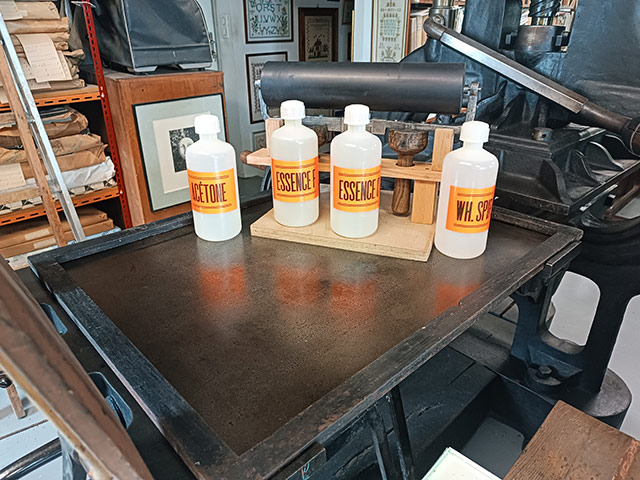
The four cans are sitting on the Stanhope’s bed, each with its handsome label and each filled with its own particular cleaning fluid. They are lined up in front of the two-handled hand roller: acetone, F-type solvent, C-type solvent, and white spirit (also known as turpentine).
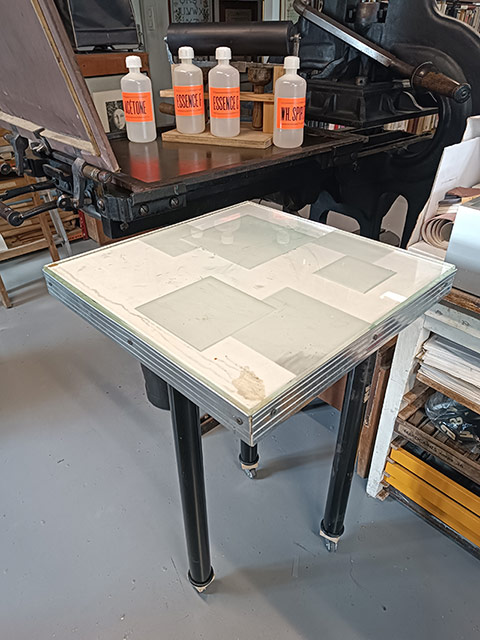
And here is the homemade inking table, cobbled together from all sorts of odds and ends, some of which have been kept for years with the thought: “These little bits and pieces might come in handy someday for making some sort of thing or other. You never know!”
But, but… oh horror!… we discover that the tabletop, made of genuine glass more than 5 millimetres thick, is absolutely filthy. Quick clean-up!
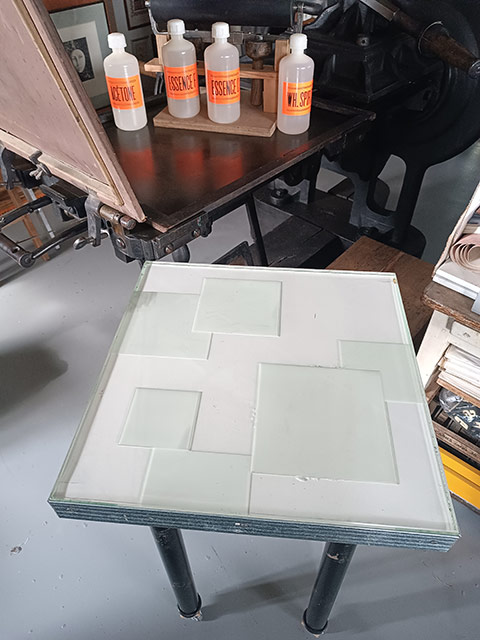
There, that’s better. With the tabletop this clean, even if we want to ink in white, there’s no danger of dirtying the colour… provided, of course, that the inking roller itself is properly clean too.
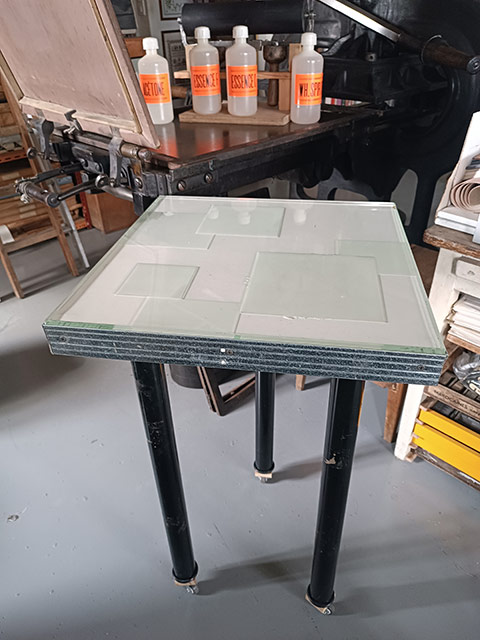
The table has only three legs, but they are fitted with casters, so it can easily be moved around. It wasn’t a deliberate decision to give it only three legs. It’s simply that, in our stockpile of odds and ends for making things out of, we could only find three. So we made do with what we had.
But admit it, it does have a certain style, this little table, with its Art Deco glass and its pretty embossed tin edging. Doesn’t it? You disagree?… Never mind. I don’t care. I like it…
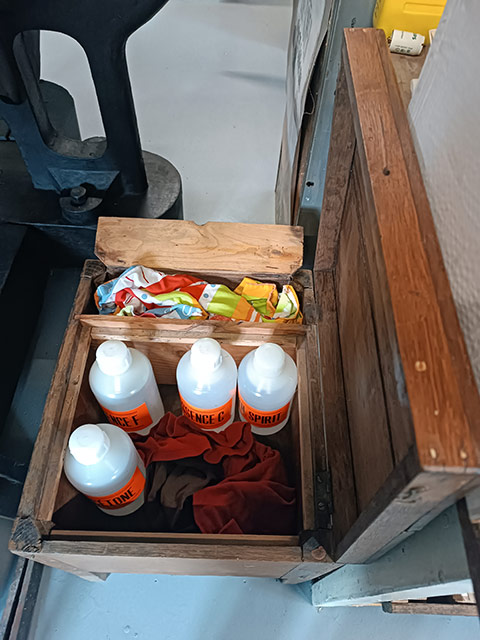
To complete the little setup, let me introduce you to this small box on legs (it has four of them!) which a friend gave me because he no longer had any use for it. I use it to store rags and cans of cleaning fluid. The clean rags, waiting patiently to get dirty, are kept in a small compartment that can be closed with a hinged lid. It’s rather sweet.
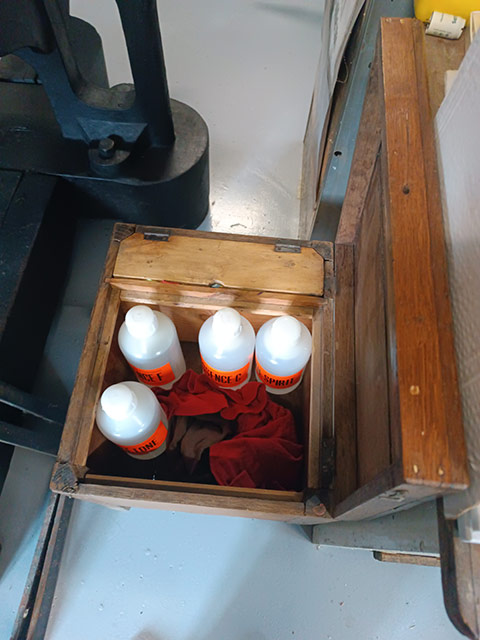
The little lid is closed.
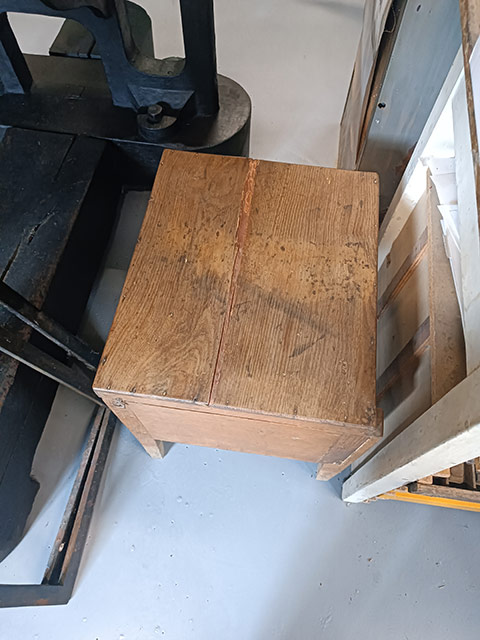
The large lid of the box is closed as well…
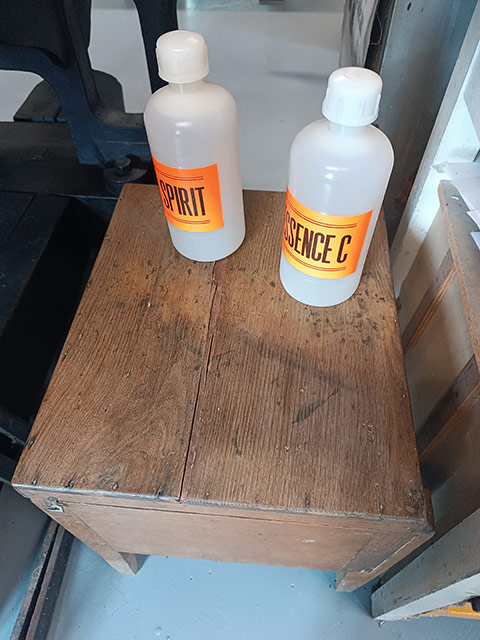
… and the cans of cleaning fluid can be placed on top. Wonderful, isn’t it?
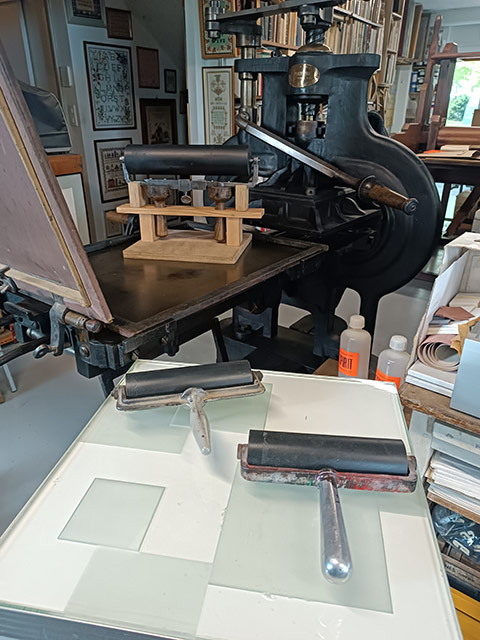
You can also put other hand rollers on the inking table, smaller ones…
—Yes, yes, very nice indeed, old chap, but when are you actually going to use that press of yours?
—Well, er… pfff… when my back hurts a little less from pulling on the bar… Soon… soon…
Not so long ago, as you may remember, I announced here that all the newly arrived Stanhope was still missing was an inking table before the press would have everything it needed to get properly to work. Well, that’s sorted now. The Stanhope has its inking table. And it has even more than that: it now has its very own cans of cleaning fluids, each one sporting a fine label printed in the workshop—black lettering on fluorescent orange paper, so you can’t possibly miss them. Come on, let’s have a look at the pictures…
The four cans are sitting on the Stanhope’s bed, each with its handsome label and each filled with its own particular cleaning fluid. They are lined up in front of the two-handled hand roller: acetone, F-type solvent, C-type solvent, and white spirit (also known as turpentine).
And here is the homemade inking table, cobbled together from all sorts of odds and ends, some of which have been kept for years with the thought: “These little bits and pieces might come in handy someday for making some sort of thing or other. You never know!”
But, but… oh horror!… we discover that the tabletop, made of genuine glass more than 5 millimetres thick, is absolutely filthy. Quick clean-up!
There, that’s better. With the tabletop this clean, even if we want to ink in white, there’s no danger of dirtying the colour… provided, of course, that the inking roller itself is properly clean too.
The table has only three legs, but they are fitted with casters, so it can easily be moved around. It wasn’t a deliberate decision to give it only three legs. It’s simply that, in our stockpile of odds and ends for making things out of, we could only find three. So we made do with what we had.
But admit it, it does have a certain style, this little table, with its Art Deco glass and its pretty embossed tin edging. Doesn’t it? You disagree?… Never mind. I don’t care. I like it…
To complete the little setup, let me introduce you to this small box on legs (it has four of them!) which a friend gave me because he no longer had any use for it. I use it to store rags and cans of cleaning fluid. The clean rags, waiting patiently to get dirty, are kept in a small compartment that can be closed with a hinged lid. It’s rather sweet.
The little lid is closed.
The large lid of the box is closed as well…
… and the cans of cleaning fluid can be placed on top. Wonderful, isn’t it?
You can also put other hand rollers on the inking table, smaller ones…
—Yes, yes, very nice indeed, old chap, but when are you actually going to use that press of yours?
—Well, er… pfff… when my back hurts a little less from pulling on the bar… Soon… soon…
There are days like that when you get up in the morning simply because you have to get up… So you get up, gloomy, thinking to yourself: “Ah! Another new day to get through…” and you set about living it, somewhat reluctantly and under duress. But nothing turns out the way you expected. The day you thought would be long, sad, and boring actually turns out to be filled with joy, wonders, and discoveries. That’s how it is—you can’t stay in the doldrums forever.
It was the contents of the mailbox that changed everything. I wasn’t expecting anything, and in fact I was half expecting a letter bearing bad news from the tax authorities or some energy provider. But instead, there was a large, beautifully made package from—oh, the surprise!—the United States. It was such a beautifully put-together package that it took me quite some time to open it, which only served to heighten the adrenaline and, consequently, the joy of discovering what was inside.
Intense joy… indeed.
What was in the package? A book. But not just any book. An important book. A landmark book. A definitive work on its subject: the typefounder's hand mould. Those moulds, as you know, were used to cast type before automatic typecasting machines were invented in the nineteenth century, followed by typesetting machines; long before the twentieth century brought us phototypesetting, and later the computerised typesetting we still use today. Without type moulds, there could have been no large-scale reproduction of the written word from Gutenberg to the dawn of mechanical typesetting.
So a type mould is no small thing. It is a cultural artifact in every sense of the word. It made the mass reproduction of writing possible; and in itself—in the way it was made, and in the way it evolved over the centuries—it stands as a remarkable expression of technological culture.
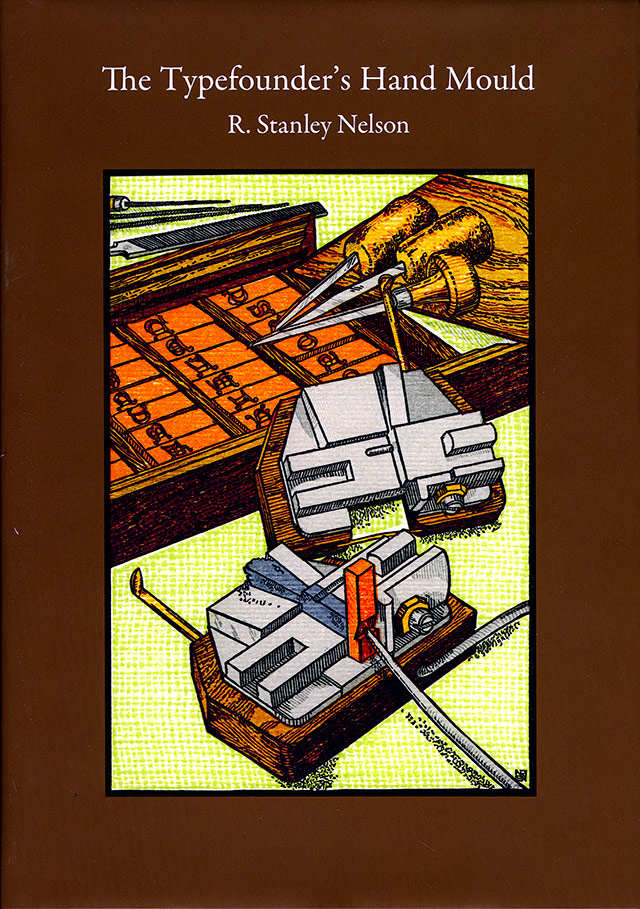
Cover.
The author of this book, Stan Nelson, is quite simply the world’s foremost authority on the subject, universally recognised as such. The book is the fruit of a lifetime of research, carried out in every country where movable-type printing has existed since the middle of the fifteenth century.
In other words, it is an indispensable book for anyone interested in traditional printing, in books, and in the technology that made them possible. As Bela, a Congolese author I published back in the last century, used to say: “It's good the Book!” And this one is not merely lavishly illustrated—it is lavishly illustrated in colour, if you please! It is a work of historical and technological scholarship that will be very hard to surpass. One might perhaps write another book on the subject after this one, but certainly not a better or more comprehensive one.
But… I can already hear the grumbling, buzzing away in my ears here and there… Grumbling, after all, is one of our great French national characteristics, a trait we are famous for the world over. We French are always grumbling.
—The book you’re talking about—it’s from the United States, isn’t it?
—Well, yes…
—So it’s in English…
—Well, yes…
—Yes, but we speak French here in France…
—Well, yes… but there’s nothing to stop us speaking English too, reading it, and understanding it. That’s part of being educated, isn’t it? And besides, the pictures are written in “picture”—a universal language. When you come across a book like Stan Nelson’s, you don’t sit around waiting for some hypothetical French translation that will probably never appear.
—Oh really? And why not?
—Because France, so proud of its famous cultural exception, has largely lost interest in traditional technologies—unlike the countries around us. And the little community of people who still care about such things is simply too small for anyone to contemplate publishing a French edition.
So, you lot: if the subject interests you, read the book in English! For heaven’s sake! And talk about it to everyone you know. That way, perhaps, we’ll make this little community of enthusiasts a little less little…
—But you can’t get the book in France…
—I don’t know about that, but you can always order it. Come on, I’ll scan the back of the dust jacket for you. All the information you need will be right there. See how kind I am to you?
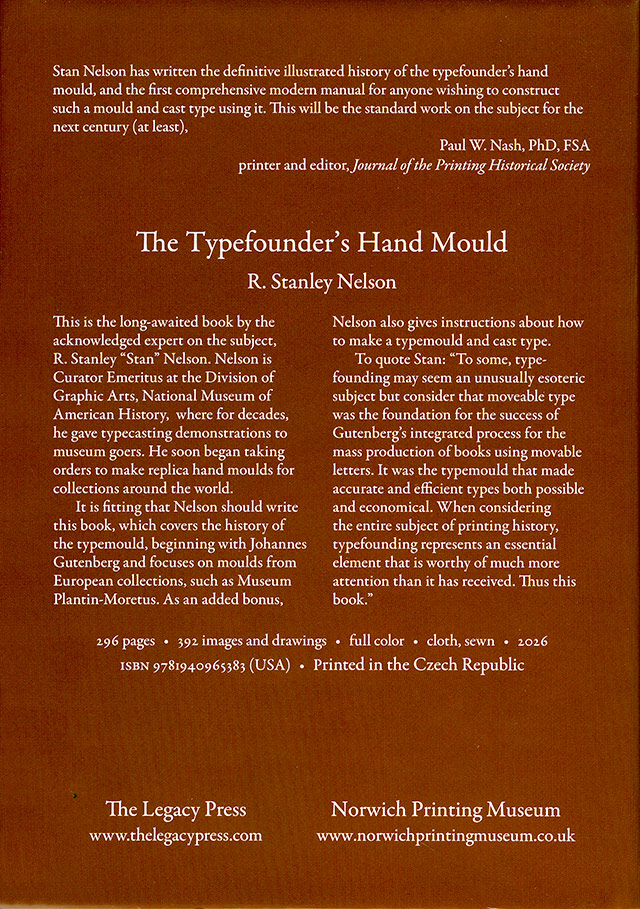
Back cover.
—But why did you get it in the mail? Did you order it?
—No. He was kind enough to send me a copy when it was published because I had given him some photographs of a mould that he discusses in the book. A few years ago, I had written a fairly substantial article about that particular mould, but it was never published because the journal it was intended for never saw the light of day.
—So you got the book for free…
—Well, yes…
—You lucky devil.
—Well, yes… You have to have a few little joys in life now and then—or some really big ones—that give you a reason to get out of bed in the morning…
There are days like that when you get up in the morning simply because you have to get up… So you get up, gloomy, thinking to yourself: “Ah! Another new day to get through…” and you set about living it, somewhat reluctantly and under duress. But nothing turns out the way you expected. The day you thought would be long, sad, and boring actually turns out to be filled with joy, wonders, and discoveries. That’s how it is—you can’t stay in the doldrums forever.
It was the contents of the mailbox that changed everything. I wasn’t expecting anything, and in fact I was half expecting a letter bearing bad news from the tax authorities or some energy provider. But instead, there was a large, beautifully made package from—oh, the surprise!—the United States. It was such a beautifully put-together package that it took me quite some time to open it, which only served to heighten the adrenaline and, consequently, the joy of discovering what was inside.
Intense joy… indeed.
What was in the package? A book. But not just any book. An important book. A landmark book. A definitive work on its subject: the typefounder's hand mould. Those moulds, as you know, were used to cast type before automatic typecasting machines were invented in the nineteenth century, followed by typesetting machines; long before the twentieth century brought us phototypesetting, and later the computerised typesetting we still use today. Without type moulds, there could have been no large-scale reproduction of the written word from Gutenberg to the dawn of mechanical typesetting.
So a type mould is no small thing. It is a cultural artifact in every sense of the word. It made the mass reproduction of writing possible; and in itself—in the way it was made, and in the way it evolved over the centuries—it stands as a remarkable expression of technological culture.
Cover.
The author of this book, Stan Nelson, is quite simply the world’s foremost authority on the subject, universally recognised as such. The book is the fruit of a lifetime of research, carried out in every country where movable-type printing has existed since the middle of the fifteenth century.
In other words, it is an indispensable book for anyone interested in traditional printing, in books, and in the technology that made them possible. As Bela, a Congolese author I published back in the last century, used to say: “It's good the Book!” And this one is not merely lavishly illustrated—it is lavishly illustrated in colour, if you please! It is a work of historical and technological scholarship that will be very hard to surpass. One might perhaps write another book on the subject after this one, but certainly not a better or more comprehensive one.
But… I can already hear the grumbling, buzzing away in my ears here and there… Grumbling, after all, is one of our great French national characteristics, a trait we are famous for the world over. We French are always grumbling.
—The book you’re talking about—it’s from the United States, isn’t it?
—Well, yes…
—So it’s in English…
—Well, yes…
—Yes, but we speak French here in France…
—Well, yes… but there’s nothing to stop us speaking English too, reading it, and understanding it. That’s part of being educated, isn’t it? And besides, the pictures are written in “picture”—a universal language. When you come across a book like Stan Nelson’s, you don’t sit around waiting for some hypothetical French translation that will probably never appear.
—Oh really? And why not?
—Because France, so proud of its famous cultural exception, has largely lost interest in traditional technologies—unlike the countries around us. And the little community of people who still care about such things is simply too small for anyone to contemplate publishing a French edition.
So, you lot: if the subject interests you, read the book in English! For heaven’s sake! And talk about it to everyone you know. That way, perhaps, we’ll make this little community of enthusiasts a little less little…
—But you can’t get the book in France…
—I don’t know about that, but you can always order it. Come on, I’ll scan the back of the dust jacket for you. All the information you need will be right there. See how kind I am to you?
Back cover.
—But why did you get it in the mail? Did you order it?
—No. He was kind enough to send me a copy when it was published because I had given him some photographs of a mould that he discusses in the book. A few years ago, I had written a fairly substantial article about that particular mould, but it was never published because the journal it was intended for never saw the light of day.
—So you got the book for free…
—Well, yes…
—You lucky devil.
—Well, yes… You have to have a few little joys in life now and then—or some really big ones—that give you a reason to get out of bed in the morning…

L’homme au coin

10 pages,
format 8,5 x 8,5 cm.
tirage à environ 30 exemplaires en typographie au plomb.
Thomas Braun
des fromages

8 pages,
format 11,2 x 9 cm.
tirage à 131 exemplaires en typographie.
CLS

Un volumen,
79 cm de long, 17,5 cm de haut.
tirage à 10 exemplaires en linogravure.
Marie-Rose de France

26 petits textes en proses poétique. Vignettes de CLS.
tirage à 120 exemplaires en typographie au plomb.
Marie-Rose de France
|
|
36 p., format 10 x 14 cm. composé et imprimé en typographie au plomb Tirage à 120 exemplaires. (cliquer sur l'image pour en savoir plus) |
... for those who are too lazy to seek.
14485752 visitors
98 visitors online
Fornax éditeur 18, route de Coizard, F51230 Bannes – France

